The Humming Hive · Bees in the Ancient World
Stories older than the written word
Bees in the Ancient World
Long before backyard hives, people were already watching bees — climbing for their honey, carving their shape into gold, and telling stories in which a bee was not a small pest, but a gift, a messenger, even a share of the divine. Here are some of those pictures and stories, told as honestly as we can.
A gentle word first
Some of this is carved in stone. Some of it is legend.
A few of the scenes below can still be visited: a painted rock shelter, a temple relief, a gold pendant in a museum case. Others come from poems, law books, and sacred stories that people loved enough to keep telling. When something is a legend, we will say so. We do not have to believe every tale in the same way. It is enough to notice how often the old world looked at a bee and saw something almost holy — the same instinct that welcomes you here, where bees are angels in disguise.
Eastern Spain
A climber, a basket, and a cloud of bees
In a rock shelter near Bicorp, in the hills behind Valencia, someone painted a small human figure reaching toward a hollow in the stone. The figure holds a vessel. Bees are scattered in the air around it. A second person is sometimes visible climbing from below. It is a honey harvest — not from a kept hive, but from a wild nest on a cliff.
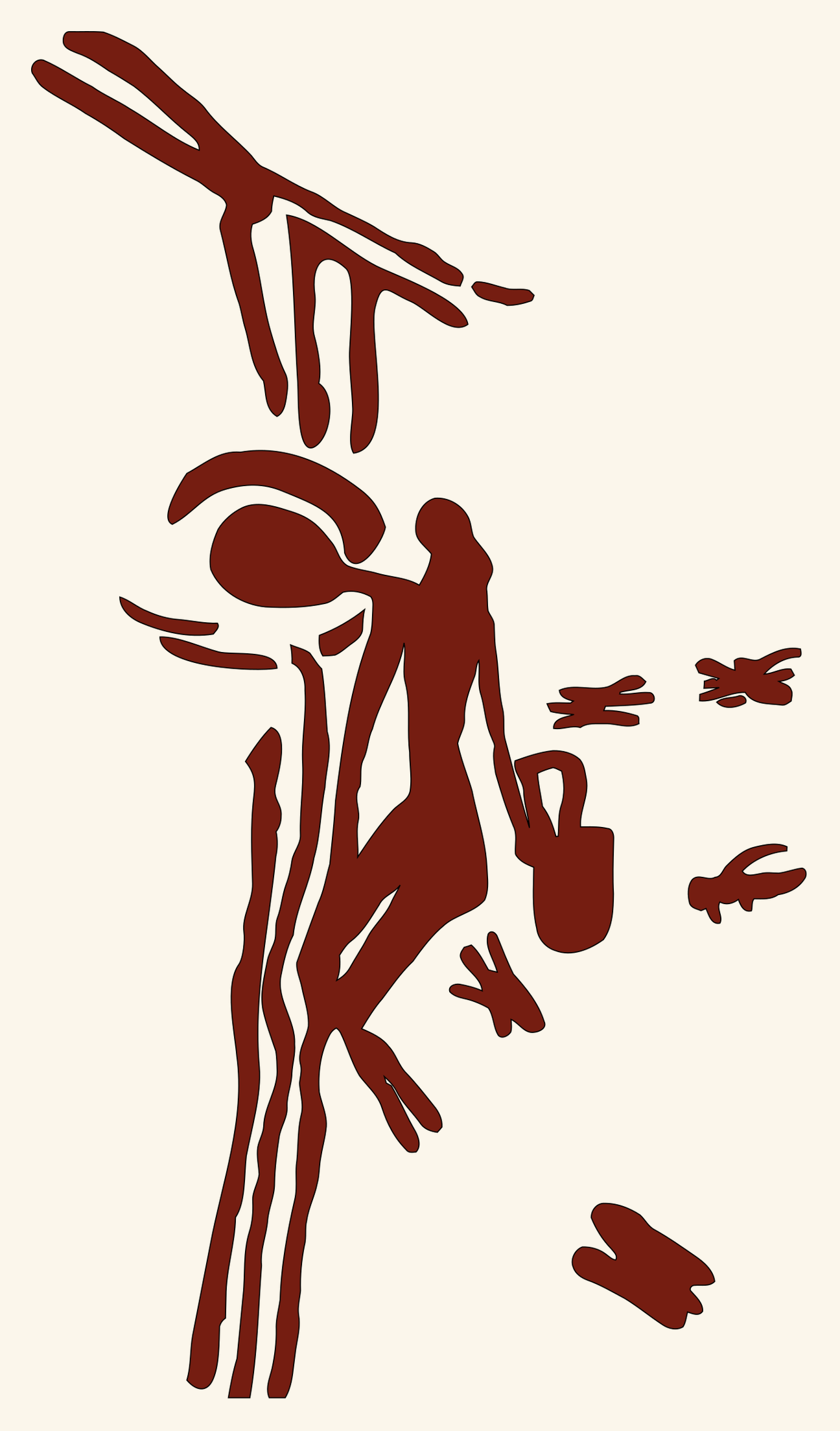

The site is often called Cuevas de la Araña — the Spider Caves — and the painting is one of the most famous images in the history of honey. It belongs to the Levantine rock art of Mediterranean Spain, a tradition of lively hunting and gathering scenes, and the shelters are part of a UNESCO World Heritage listing.
You will often read that the picture is about 8,000 years old. That figure is a common estimate, and it may be close — but specialists still debate the dating of this style of art, because the mineral paint is hard to date directly. What is not in serious doubt is the subject: people already thought a climb for wild honey was worth painting.
One careful distinction, because captions sometimes blur it: this is honey hunting, not beekeeping. There is no managed hive here. The first clear pictures of people tending hives come later, in Egypt.
Sources: Museo Nacional de Ciencias Naturales (CSIC); UNESCO, Rock Art of the Mediterranean Basin on the Iberian Peninsula.
Ancient Egypt
Tears of the sun, and the bee of a king
In Egyptian story, bees are not a happy accident of the fields. They are born from the sun god himself. An ancient text, often quoted by historians of beekeeping, says that the god Re (also written Ra) wept, and that his tears, falling to the ground, became a bee. The bee went among the flowers, and from those tears came both wax and honey.
That is a sacred story, not a scientific explanation. It tells us how precious bees were: their honey and wax were imagined as a gift from the sun.
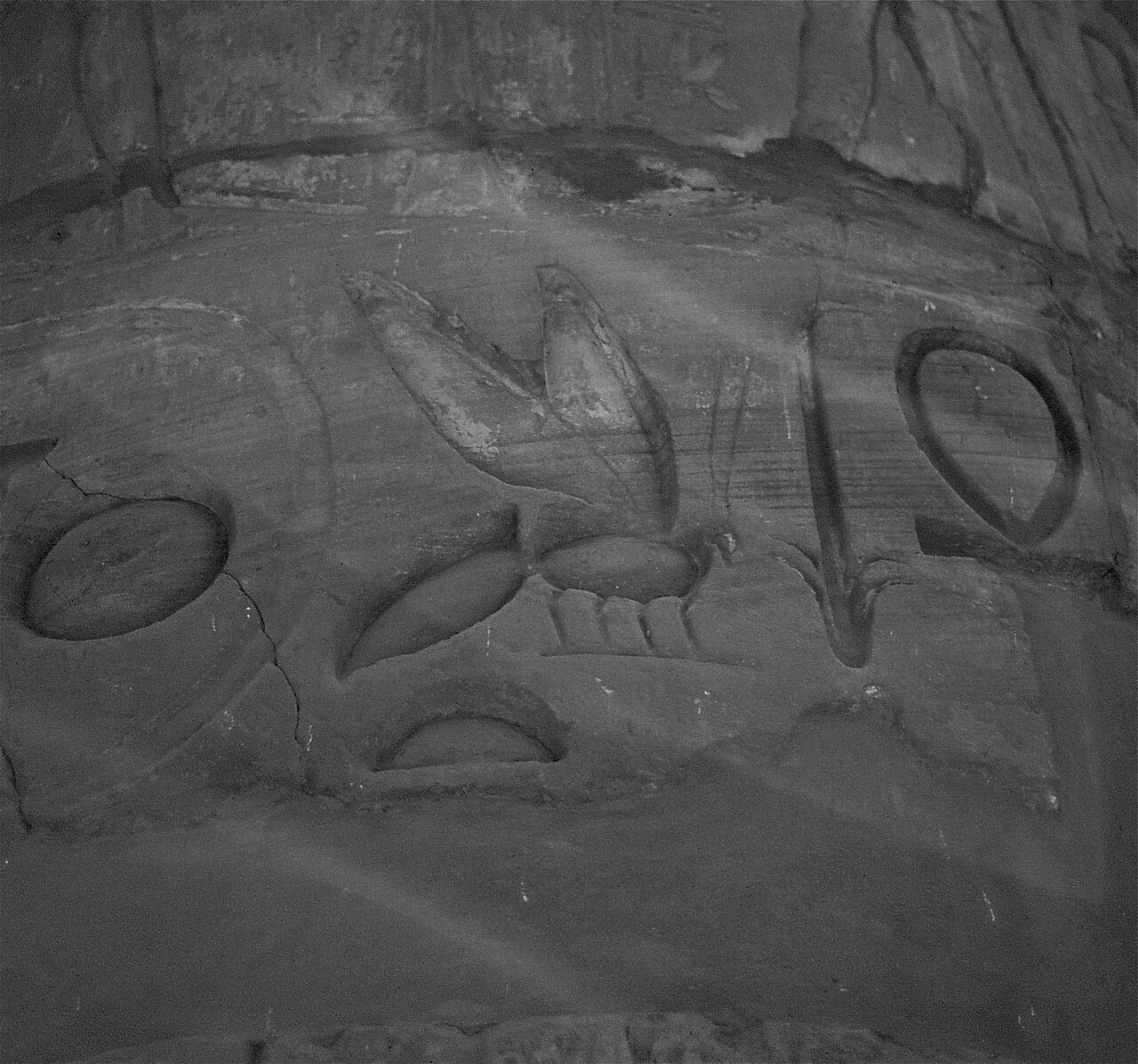

The bee was also a royal sign. From the First Dynasty onward, one of the pharaoh’s titles can be translated “He of the Sedge and the Bee.” The sedge stood for Upper Egypt, the bee for Lower Egypt — the two lands brought together in a single name. The little insect, in other words, was written into kingship itself.
And the Egyptians did not only honor bees in words. In the sun temple of King Nyuserre, at Abu Ghorab near Abusir — about the mid-25th century BCE, more than four thousand years ago — artists carved scenes of beekeeping: stacked horizontal hives, most likely clay tubes, and workers taking comb, filling jars, pressing, and sealing honey. It is one of the earliest clear pictures we have of people keeping bees, not only hunting them. The relief is now in Berlin.
Honey was food, medicine, offering, and tribute. It appears in many medical recipes, and it was given to the gods and placed with the dead. Jars connected with honey have been found in tombs. A popular modern story says archaeologists opened thousand-year-old pots and found the honey still good to eat. That tale is not well documented, so we will not repeat it as fact. What we can say, more quietly, is that honey was valuable enough to accompany a person into the next world.
Sources: Gene Kritsky, interviewed for The World (PRX), on The Tears of Re; International Association of Agricultural Museums, “Bees in Egypt of the Pharaohs”; Abdel-Rahman, “Bees and Beekeeping in Ancient Egypt,” Journal of Association of Arab Universities for Tourism and Hospitality.
Ancient Greece
Priestesses called bees, and a child fed on honey
In Greek, melissa means “bee.” The word was not only for the insect. Priestesses of certain goddesses — including Demeter, and the Artemis worshipped at Ephesus — were called Melissae, “the bees.” In the fifth century BCE, the poet Pindar called the prophetic priestess of Apollo at Delphi the “Delphic Bee.”
Legend
One old story says that a nymph or princess named Melissa helped hide the infant Zeus in a cave on Crete, and that he was fed on honey. In a world where honey was the great sweetness, that is a tender way of saying a god was raised on the gift of bees.
Another figure, Aristaeus, was remembered as a rustic hero or god who taught people useful country arts, including the keeping of bees. He will appear again in Rome, in the poem that closes this next chapter.
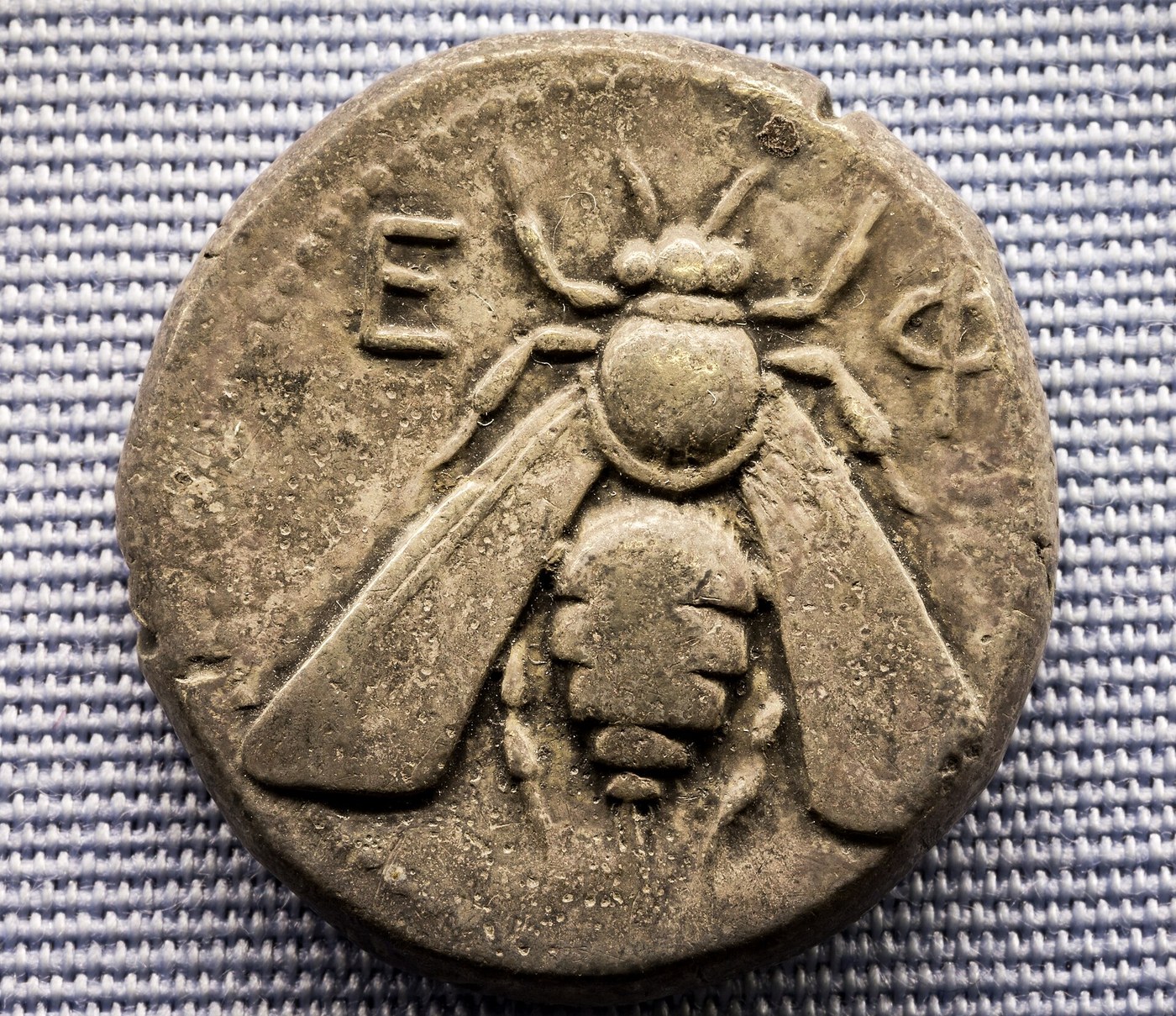

At Ephesus, on the coast of what is now Turkey, the great sanctuary of Artemis was thick with bee imagery. The priestesses were “bees,” and the chief priests were called essenes — “king bees.” (The ancients thought a hive was led by a king, not a queen.) Early excavations at the sanctuary, led by D. G. Hogarth for the British Museum, found gold ornaments in the shape of bees. The Museum still holds a small gold pendant in the form of a bee’s body, dated to about 650–600 BCE. The same insect flew, as we see here, on the city’s coins.
Sources: Pindar, Pythian 4 (the “Delphic Bee”); Macquarie University, “The Coinage of Ephesus”; University of Colorado, Ephesian tetradrachm with a bee; British Museum, gold bee pendant from the Sanctuary of Artemis.
Rome
Virgil’s bees, and a share of the divine mind
In the late first century BCE, the Roman poet Virgil devoted the whole fourth book of his Georgics — a long poem about country life — to bees. He watches them with real affection and with a farmer’s eye: their work, their order, the way a hive can seem like a little city.
He also lets the wonder stand. Some people, he says, looking at such signs, have held that bees have a share of the divine mind, and drink in something of the heavens. It is not a laboratory claim. It is a poet, two thousand years ago, circling the same feeling that still stops us beside a hive: that there is more in that murmur than industry alone.
Legend, in a poem
The book ends with a story about Aristaeus. In Virgil’s telling, Aristaeus loses his bees after he causes the death of the nymph Eurydice. Following his mother’s counsel, he offers sacrifices, and new bees rise from the bodies of the cattle — a myth of loss and return. Ancient writers sometimes taught that a swarm could be born from a dead ox. That belief, called bugonia, is a legend, not something that happens in nature. What remains is the poem’s hope: that even after a hive is gone, life might begin again.
Sources: Virgil, Georgics, Book 4 (especially the lines on bees sharing in the divine mind, and the Aristaeus story at the close); Dickinson College Commentaries, Georgics 4.
Hindu tradition
A bowstring of bees, and a goddess who hums
In Hindu sacred art and poetry, Kamadeva — the god of love — is often shown with a bow of sugarcane, arrows of flowers, and a bowstring made of honeybees. It is a picture of love’s sweetness, and of spring, when bees and blossoms return together. The bees are not a threat in this image. They are the very string that lets love fly.
Sacred story
Another name to hold is Bhramari, a form of the Goddess whose name is tied to the bee and to a humming sound. In the Devi Bhagavata Purana, she appears and overcomes the demon Arunasura by sending forth bees and other flying insects. That is a religious narrative, not a historical report. Even so, it places the bee — small, many, and fierce in defense — at the side of the divine.
Sources: Jeffery D. Long, “This god shoots love darts — but no, it’s not Cupid,” The Conversation; The Devi Bhagavata Purana (Vijnanananda translation; the Bhramari story is in Book 10, Chapter 13).
The Maya world
The royal lady bee, and a god of honey
When we picture a bee, many of us picture the European honey bee. In the Maya world of the Yucatán, the beloved honey maker was a different insect: a stingless bee, especially Melipona beecheii, called in Yucatec Maya Xunan Kab — often translated “royal lady bee.”
These bees have been kept in hollow logs for many centuries. Archaeological evidence for stingless-bee keeping in Mesoamerica goes back more than two thousand years. Their honey was used in ritual, in medicine, and in the making of balché, a fermented honey drink. Families still keep them today, and the bees are still spoken of with reverence.
The Maya god of bees, honey, and beekeeping is Ah-Muzen-Cab (the name is also spelled Ah Mucen Cab or Ah Muzencab). One of the few surviving Maya books, the Madrid Codex, includes pages devoted to bees and their care. The European honey bee had not yet arrived. This was a sacred relationship with a gentle, stingless bee — a reminder that “the bee” has always been a whole family of beings, not a single face.
Sources: ICT News, “Sacred bees are vital to Mayan culture”; Aldasoro Maya et al., “Stingless bee keeping,” Frontiers in Sustainable Food Systems (2022).
Ireland
Bee-judgments, and a law for little livestock
In early medieval Ireland, bees were important enough to have their own law tract. The Bechbretha, or “bee-judgments,” was written down in the seventh or eighth century, as part of the wider tradition of Brehon law. It deals with swarms, neighbors, theft, and even what is owed if a bee stings someone. Bees were treated as livestock of real value — makers of honey, mead, and wax — and the laws tried to keep peace between the people who kept them.
Sources: Chris Doyle, “Why early medieval Ireland had laws for bees,” The Conversation.
Ballyvourney, County Cork
Saint Gobnait, who kept the bees
Irish tradition remembers St. Gobnait — also called Gobnat or Gobnet — as a woman of the sixth century, the patron saint of Ballyvourney (Baile Mhúirne) in County Cork, and a patron of beekeepers. There is no early Life written about her alone. What we have is later memory: a ninth-century calendar of saints, the Félire Óengusso, already marks her feast on February 11, and medieval Lives of St. Abbán say he founded a monastery at Ballyvourney and gave it into her care. Some tellings say she came from County Clare, or from the island of Inis Oírr in the Aran Islands, before she made her home in Cork. She is also remembered as a patron of ironworkers, a quieter strand of the same devotion.
A legend of nine white deer
One of the best-loved stories of her journey is a legend. An angel, the story goes, told her she would find the place of her resurrection — the place she was meant to rest — marked by nine white deer grazing together. Some versions say she saw a smaller group of deer at an earlier stopping place along the way. At last, on the hillside of Gort na Tiobratan in Ballyvourney, she found the nine, and there she founded her cell and her community.
The bees who defended a village — a legend
Tradition says Gobnait kept bees for their honey and their wax. And around that simple work grew another legend, told in more than one way. In a well-loved telling, raiders — or, in other versions, cattle thieves — came against Ballyvourney, and she set her bees on them. The bees drove the attackers away. Other tellings are more wondrous still: that the bees became soldiers, or that a hive, blessed in her hands, was changed into a brass helmet, and the bees into fighting men. These are stories, passed down with affection, not court records. They still tell us something: in the Irish imagination, bees could stand as protectors of a community.


Her feast day is still February 11, and a second great gathering is held on Whit Sunday. Pilgrims have been coming to Ballyvourney for centuries — so many that, in 1601, Pope Clement VIII granted an indulgence to the faithful who visited her church on the feast. People still walk the rounds, called Turas Ghobnatan: a slow, clockwise path of prayer that moves from station to station — around her house, or hut site, and a modern limestone statue of her; on to her grave and the old medieval church in the graveyard; and at last to her holy well, Tobar Ghobnatan. There, many take a drink of the water, which is believed to have healing power, and leave behind small offerings — rosaries, bits of cloth, statues — at the well and on the rag tree beside it. Along the way, many also stop at a round stone, or bulla, set in the old church wall, long believed to bless and heal. The rounds can be made on the feast days, or at any time, for oneself or for someone who is ill.
A rare medieval wooden statue of Gobnait is kept in the Catholic parish church in the village. It is carved of oak, about twenty-seven inches tall, and is usually dated to the thirteenth or fourteenth century — one of only five such medieval wooden statues of Irish saints still known. For most of the year it stays in the sacristy; on her feast day and on Whit Sunday it is brought out. On those days, pilgrims have long kept a custom called Tomhas Ghobnatan, or Gobnait’s measure: a ribbon, or a length of woollen thread, is laid along the statue and wrapped around the neck, the waist, or the feet, then taken home as a blessing, and, in popular belief, a protection from illness. Farmers were also said to hang such a ribbon in the sheds where their animals were kept. Examples of those ribbons are now held by the National Museum of Ireland.
Across the road from the graveyard stands that later limestone statue, carved by the Cork sculptor Séamus Murphy and unveiled on Whit Sunday in 1951, with bees cut into its base. Gobnait is remembered in other places too — at Cill Ghobnait on Inis Oírr, and at a holy well in Dún Chaoin, County Kerry, where rounds are still made, and where offerings have included stones, coins, and jars of honey. There is even an older tradition of a bronze bell said to have been hers. The devotion has never been only a story in a book. It is still walked, still measured in ribbon, and still, in its own quiet way, a love of bees.
Sources: Irish Heritage News, “St Gobnait: patron saint of ironworkers, beekeepers and Ballyvourney,” 11 February 2024; Alison Ray, “All you need to know about Cork’s medieval beekeeper St Gobnait,” RTÉ Brainstorm, updated 12 February 2026; D. Ó hÉaluighthe, “St Gobnet of Ballyvourney,” Journal of the Cork Historical and Archaeological Society 57 (1952); M. T. Kelly, “Saint Gobnata, and her hive of bees,” Journal of the Cork Historical and Archaeological Society 3 (1897); Dúchas, National Folklore Collection, “St Gobnait’s Beehive”; National Museum of Ireland, ribbons from “Saint Gobnait’s measure.”
A custom kept in many countries
Telling the bees
There is also a quieter custom, kept not only in Ireland but in Britain, other parts of Europe, and later in places such as New England: telling the bees. When someone in the household died — and sometimes when there was a wedding or a birth — a person would go to the hives and speak the news. The hives might be draped in a scrap of black cloth. The bees might be asked, gently, to stay. Folklore warned that if you forgot, the colony might leave or die.
Some writers have wondered whether the custom grew from older ideas of bees as messengers between this world and the next. That origin is not something we can prove. What we can say is that the practice treats the hive as family. You would not let a death pass in the house and leave the bees uninformed. You would tell them, as you would tell anyone you loved.
Church and Middle Ages
Wax for a holy light
For centuries, beeswax was the preferred wax for church candles — especially the tall Paschal candle lit at Easter. In the Exsultet, the great Easter Proclamation sung at the Vigil, that candle is praised as the work of bees as well as of human hands, and the wax is described as drawn out by mother bees. A commentary from the U.S. Conference of Catholic Bishops notes that earlier medieval versions of the hymn included a much longer passage in praise of the bees themselves.
Medieval writers also loved the hive as a picture of a well-ordered, hardworking community. They did not always get the biology right — they, too, often imagined a “king” at the center — but they recognized devotion when they saw it. A later Christian legend says that when St. Ambrose was an infant, a swarm of bees settled on his face and left a drop of honey, taken as a sign of the sweet speech he would one day have. That is a legend. The older, sturdier fact is simpler: when the church wanted a clean, bright flame for its most sacred night, it turned to the bees.
Sources: Fr. Michael J. Flynn, “The Exsultet: Christ Our Light,” U.S. Conference of Catholic Bishops; the Easter Proclamation (Exsultet) in English.
A later echo
Golden bees, from a king’s tomb to an emperor’s cloak
This last story is later than the ancient world, but it begins in an early medieval grave, and it shows how an old emblem can be taken up again.
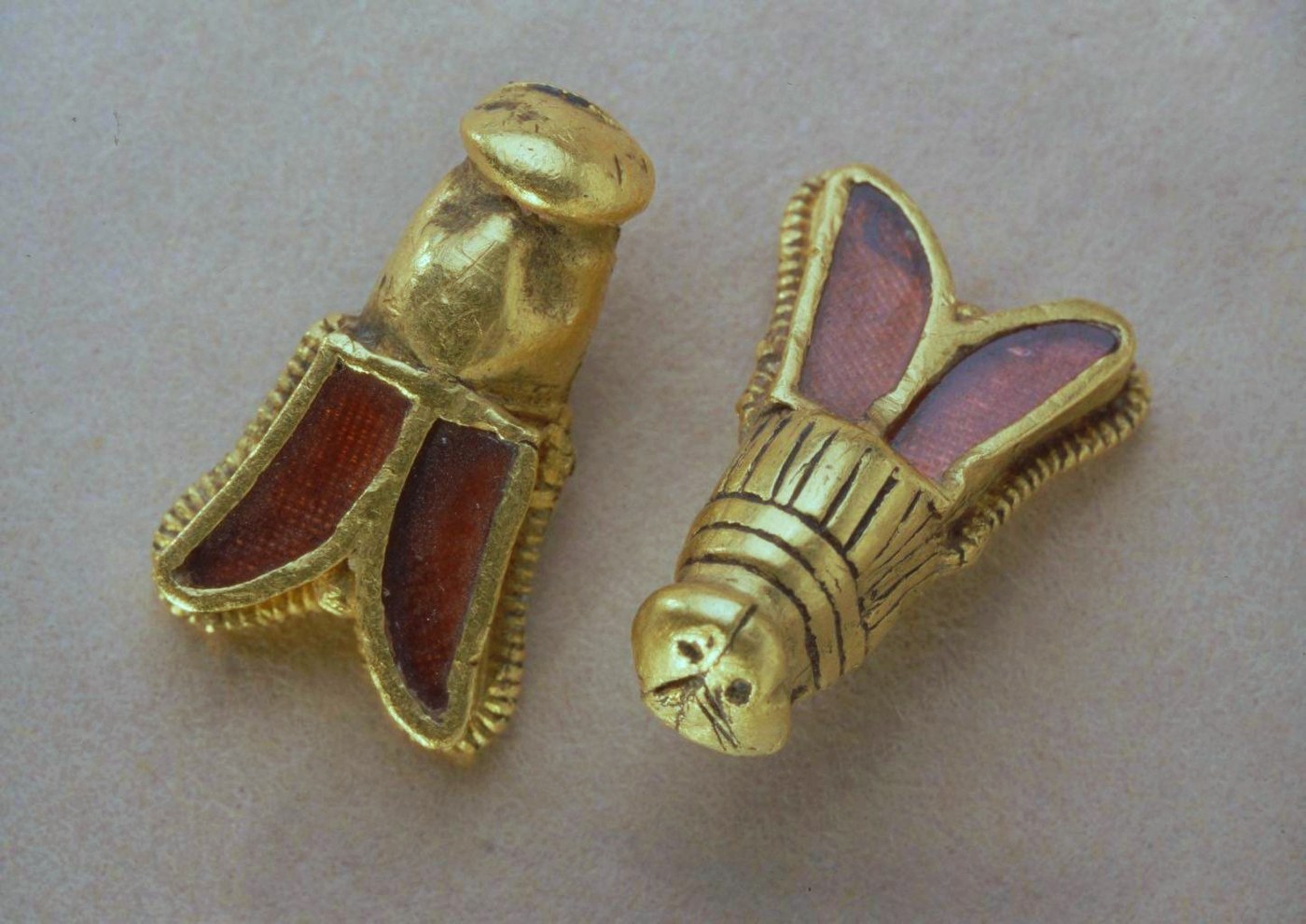

In 1653, at Tournai, the tomb of the Frankish king Childeric I was found. Childeric died in the late fifth century. Among the grave goods were hundreds of small gold insects with garnet wings, traditionally called bees. Some scholars have since wondered whether they might be cicadas or flies rather than bees. The objects have been loved and copied as bees for centuries, and that is how Napoleon understood them.
When he became emperor, Napoleon wanted a symbol older than the fleur-de-lis of the Bourbon kings. He chose the bee. Bees were embroidered on his coronation mantle in 1804, and they appeared across the art and furnishings of the First Empire — a little golden insect, carried from a Merovingian tomb into a new court, still doing the old work of standing for permanence, order, and a kind of quiet royalty.
Sources: Library of Congress, “Merovingian Bees”.
What the old stories share
Again and again, a bee is more than an insect.
A tear of the sun. A sign on a king’s name. A priestess. A share of the divine mind. A string on the bow of love. A royal lady in a hollow log. A neighbor who deserves to be told when the house is in mourning. A maker of the wax that holds a sacred flame.
We do not have to flatten these stories into a single lesson, or pretend that every date is certain. It is enough to notice how widely, and how tenderly, people have looked at bees and seen a gift. That is why this house is called The Humming Hive — and why, if you listen closely, you may still hear the old thought humming underneath: bees are angels in disguise.